Inside Global Convenience: A Conversation with the Artists

PUBLISHED: JUNE 16, 2026
In This Blog
- Global Convenience offers an artistic interpretation of Toronto’s role as a FIFA World Cup host city, capturing the global exchange and shared cultural energy that define this moment
- A familiar corner store is reimagined on the water, highlighting everyday spaces as sites of cultural connection and identity
- The waterfront setting shapes the artwork’s design, materials, and experience in unexpected ways
- Visitors are invited to look closer and discover layered details that feel both local and international
- Global Convenience, as a replica convenience store, is designed to be experienced from the shoreline, where its familiar form and unexpected setting can fully come into view
Toronto is welcoming the world as a Host City for the FIFA World Cup, and Global Convenience arrives at this moment shaped by global exchange and connection. Set within Harbour Square Basin, the artwork brings together these themes by reimagining one of the most familiar spaces across cultures, the neighbourhood convenience store, and placing it at the water’s edge where people, goods, and ideas have long arrived and intersected.
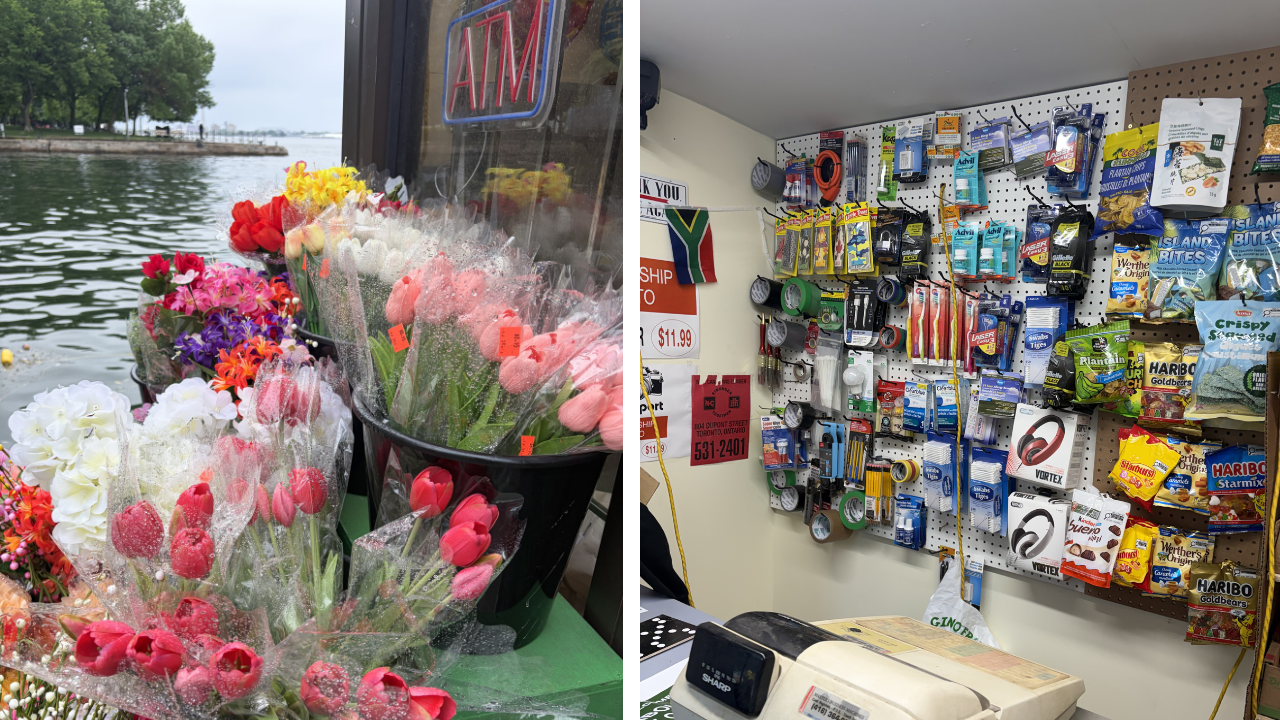
Corner stores exist in cities around the world, serving as small but meaningful sites of connection. By translating this shared urban experience into a floating public artwork, Global Convenience invites visitors to reflect on the cultural exchange that unites Toronto and cities worldwide.
To better understand the thinking behind the project, we spoke with artists Trevor Wheatley and Cosmo Dean about their approach to site, timing, and the familiar rituals that continue to define how we experience the city.
Why did a floating convenience store feel like the right response to the moment and to the Harbour Square Basin?
When Waterfront Toronto released its call for proposals, Cosmo and I saw it as an opportunity to develop a project with old friends. We joined forces with Puncture, an arts-focused production company led by Rashad Maharaj and Spencer Cathcart, and began exploring how we might respond to the site and the moment. From the outset, the project was a collaborative effort, and Puncture's support and expertise were integral in helping transform the concept into a realized public artwork.
While this is our first project with Puncture, our artistic practice has long focused on recontextualizing language and visual cues from urban environments by placing them within natural settings. That juxtaposition creates new meanings and encourages viewers to reconsider their relationship to the familiar symbols and systems that shape everyday life.
For this project, we saw an opportunity to further elaborate that concept. Rather than relocating a single word or sign, we transplanted an entire urban typology, a convenience store, into an unexpected environment. A convenience store is one of the most recognizable and universal spaces in the world. Whether you're in Toronto, Tokyo, São Paulo, or Lagos, there is a version of this type of business within any given community.
The timing of the project felt especially meaningful as Toronto prepares to welcome visitors from around the globe for the FIFA World Cup. We began thinking about the convenience store as a kind of cultural crossroads. It is a place where products, languages, traditions, and identities coexist in one contained space. By filling the store with products from different countries, Global Convenience reflects the ways culture travels around the world.
Harbour Square Basin added another layer to the idea. Water has long been associated with movement, trade, and exchange, making the harbour a fitting setting for a project about importation, connection, and Toronto's reputation as a cultural melting pot.
Corner stores are everyday spaces where cultures meet. What is a small, ordinary moment that deserves more recognition as an act of care or connection?
One of the things we appreciate most about corner stores is that they facilitate connection. They are places where people become familiar with one another through small, repeated interactions. You get to know the owners, they recognize their regular customers, and over time those brief exchanges become part of the social fabric of a neighbourhood.
What is especially meaningful is that this experience feels universal. Your local corner store often serves as an informal community hub. It is a place where people from different backgrounds cross paths in the course of everyday life, where multiple languages are spoken, and culturally specific products, cuisines and artifacts become available. These environments almost incidentally curate an atmosphere of cross-cultural recognition, influence and inspiration.
What surprised you most about working on water, and how did it influence the design?
The water proved to be both an inspiring and challenging environment to work within. Unlike a typical public art site, every design decision had to account for buoyancy, wind, weather, and weight. Materially, we had to think carefully about creating something durable enough to withstand unpredictable elements while remaining light enough to stay afloat.
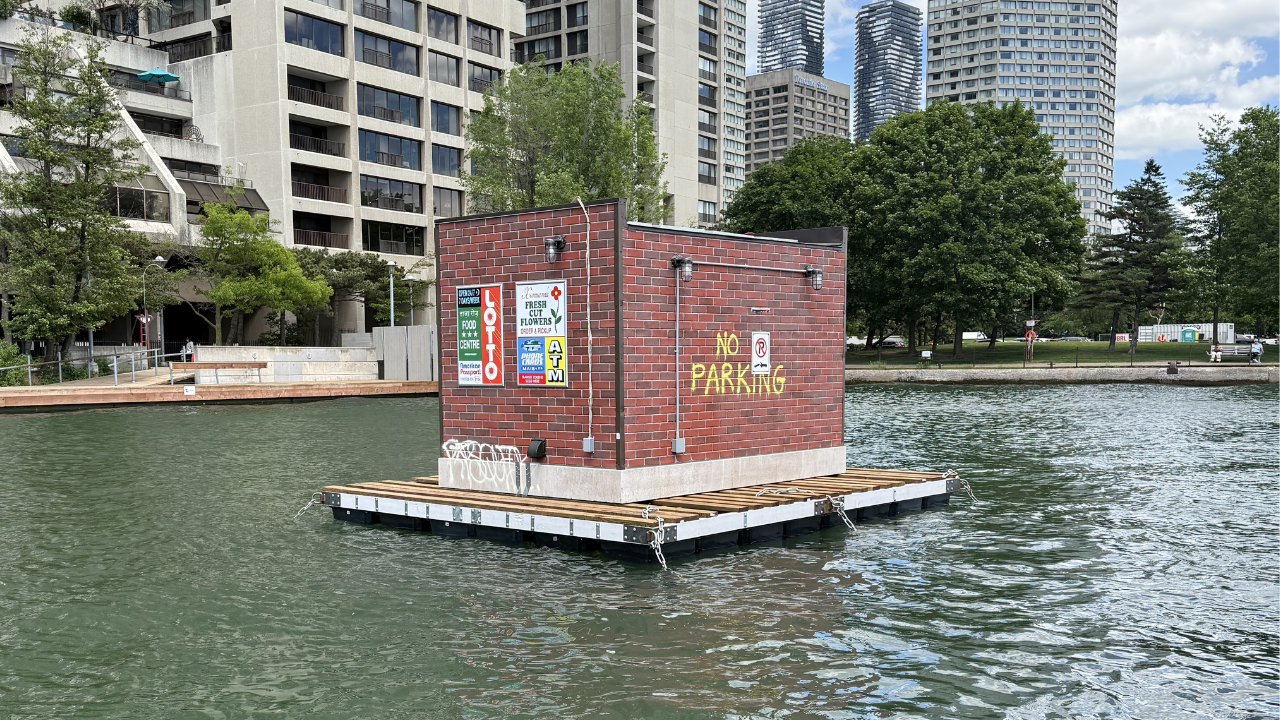
These constraints ultimately came to inform the project’s design. The dock became larger, the building slightly shorter, the walls were fabricated from vacuformed plastic to reduce weight, and elements like the fire hydrant were sculpted from foam rather than heavier materials. Working on water required us to rethink familiar urban forms through an entirely different set of physical conditions, which ultimately became an important part of the work itself.
From a distance and up close, what do you hope visitors notice first?
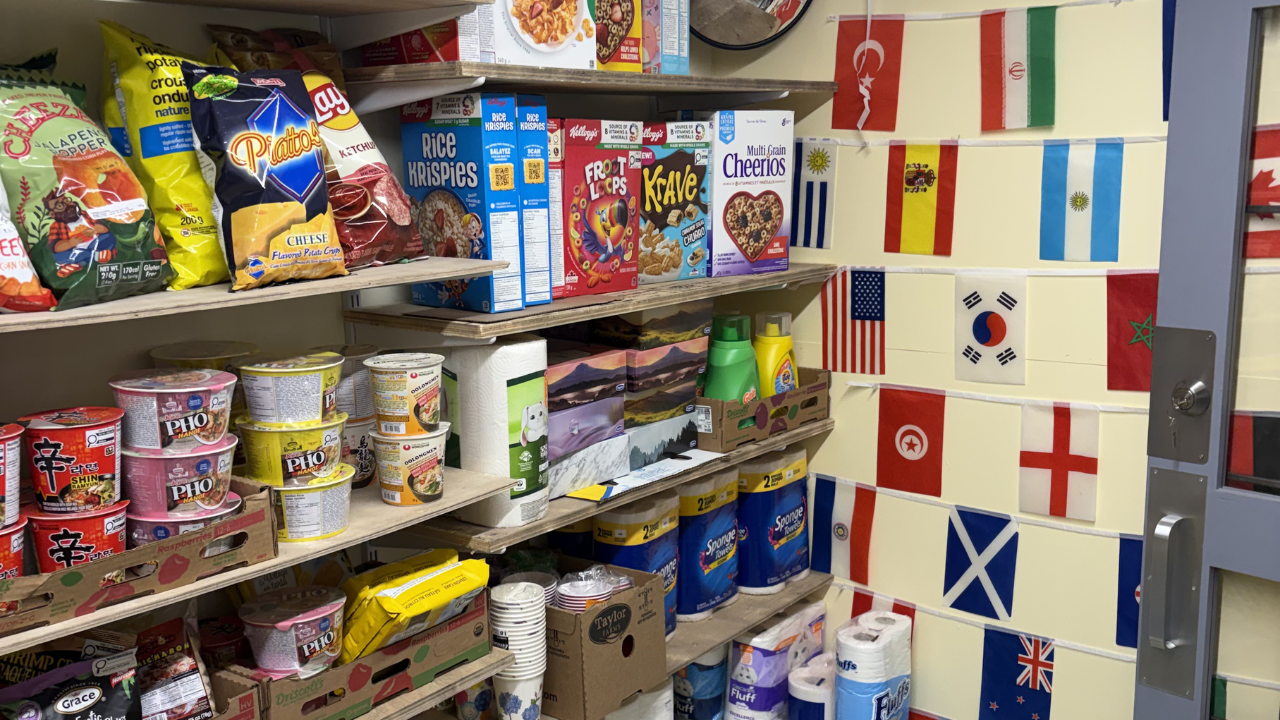
From a distance, I hope people experience a moment of surprise. The familiar silhouette of a neighbourhood convenience store is instantly recognizable, but seeing one floating in the harbour is unexpected. There is an initial moment of disbelief, followed by curiosity. Up close, we hope the space feels authentic, lived in, and welcoming, like a real local convenience spot. We put great effort into sourcing international products, creating subtle patinas to suggest use and history, and designing geo specific and globally recognizable graphics.
Together with the team at Puncture, we looked closely at convenience store branding and signage from around the world, drawing inspiration from countries including Japan, Brazil, the US, and Turkey. Many details may remind visitors of places they have lived or travelled, while others feel entirely new, making the work simultaneously familiar and multicultural.
How does Global Convenience change from day to night?
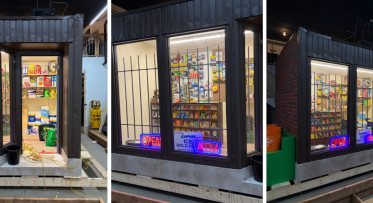
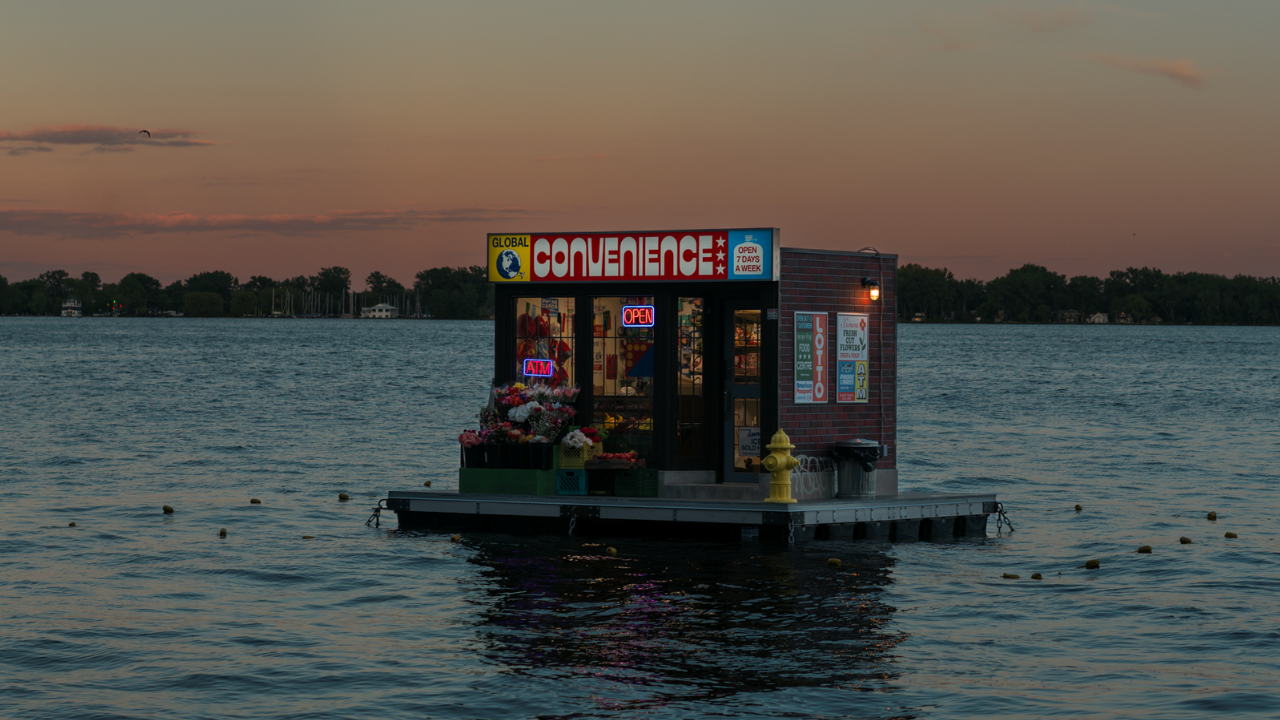
We took a crash course in solar power in order to ensure Global Convenience could remain active after dark. At night, a large traditional lightbox sign, exterior lighting, and a brightly lit interior remain illuminated in contrast to the darkness of the lake.
We carefully selected signage colours that contrast with the lake’s dark tones at night. After dark, the work shifts from curiosity into something more atmospheric and awe inspiring, where light becomes the primary way of connecting the structure to the surrounding city and shoreline.
What do you hope people take away from the work, and what advice would you share with artists responding to public art calls?
We hope the project encourages its viewers to reconsider the familiar. If people walk away thinking about the small spaces they pass every day, and the artifacts of globalization embedded within them, that would feel like a meaningful outcome. We also hope it encourages a deeper appreciation for how context shapes understanding and how experiencing this work on the waterfront challenges viewers to notice what they often overlook.
For artists responding to temporary public art opportunities, our advice would be to begin with close attention to site and context, and to stay open to how those conditions can influence what you create. Site specific work often requires balancing concept with constraints, but those constraints can be generative. Our strongest ideas are often the ones that evolve in dialogue with their setting rather than being imposed upon a place.
Visit Global Convenience
Global Convenience is now on view at Toronto’s Harbour Square Basin until October as part of Waterfront Toronto’s annual Floating Public Art program. Visitors can experience the artwork from the waterfront promenade along Queens Quay West, at Harbour Square Park, near the Jack Layton Ferry Terminal.
Take a moment to pause and take it in from afar to appreciate how familiar details reveal themselves in a new setting.