You Complete Me: Experience the Unfinished Arch at Sherbourne Common

PUBLISHED: JUNE 12, 2026
In This Article
- Waterfront Toronto’s destination art piece for Sherbourne Common is now on view
- Unfinished Arch, by acclaimed artist Rafael Lozano Hemmer, invites participation and becomes complete through contact
- Rafael Lozano-Hemmer and the fabrication team share more about their inspiration, process and hopes for the piece
- Unfinished Arch incorporates accessibility features that support inclusive interaction for visitors of different heights and abilities
- Visitors who engage with Unfinished Arch are encouraged to share their experience through Instagram
- Unfinished Arch builds on Waterfront Toronto’s long term vision for East Bayfront, and complements nearby artworks, Light Showers and LIGHTKEEPER
Waterfront Toronto’s destination art piece in Sherbourne Common is now open. Unfinished Arch, a long-awaited destination public artwork by internationally recognized artist Rafael Lozano Hemmer invites the public to visit, experience and complete the Arch through their presence and touch.
Watch You Complete Me on YouTube to get a glimpse of the opening day.
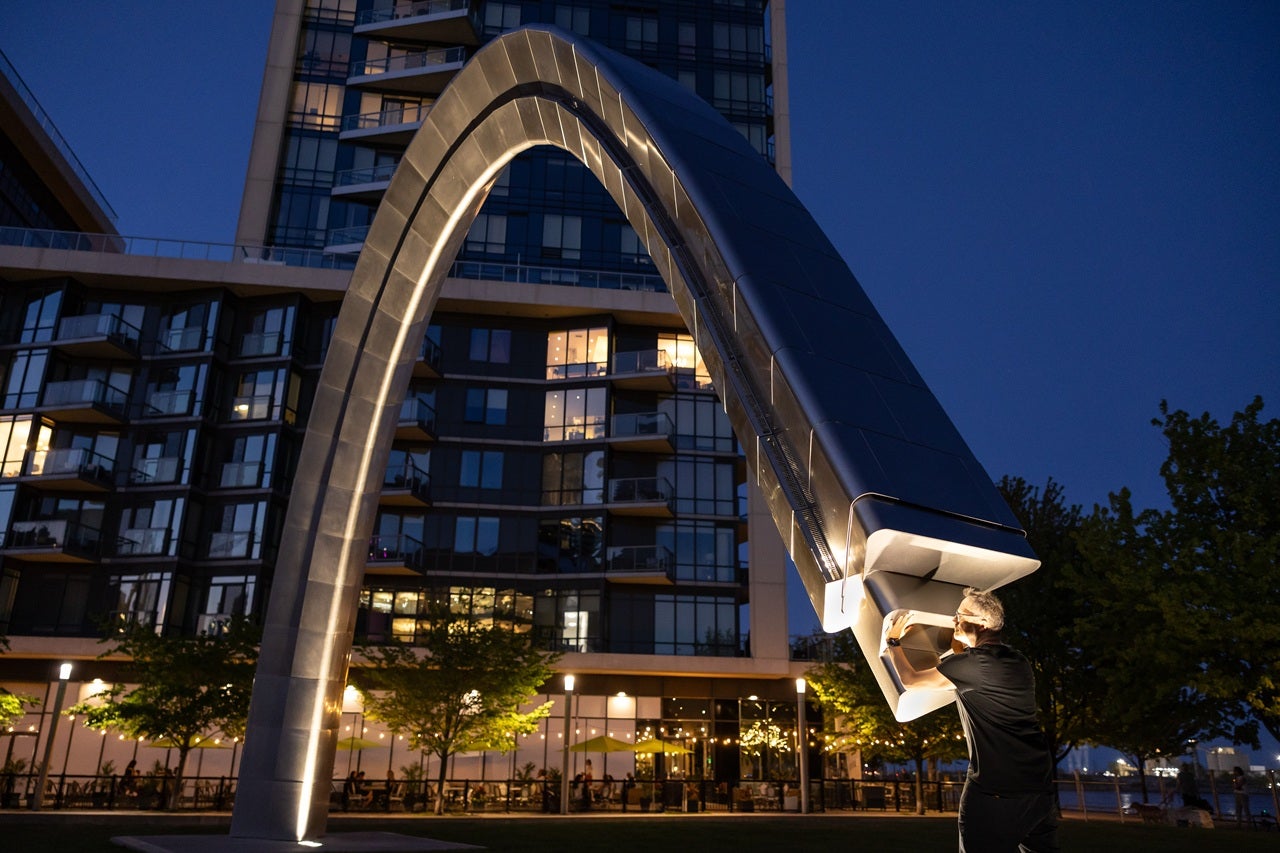
Artist Rafael Lozano-Hemmer illuminating Unfinished Arch in Sherbourne Common.
Announced in 2024, Unfinished Arch was selected through an international call for proposals that attracted more than 80 global submissions. With Unfinished Arch, Rafael Lozano Hemmer brings his participatory practice to Toronto’s waterfront in a permanent form for the first time.
Delivering an artwork of this scale and complexity required careful collaboration across disciplines. Toronto based design and fabrication firm, Eventscape, worked alongside the artist and Waterfront Toronto to engineer, fabricate, and install a structure that is visually striking and meets the complex technical demands of a waterfront environment.
To learn more about the ideas, collaboration, and innovation behind the creation of Unfinished Arch, we spoke with the team about bringing this highly anticipated artwork to life.
Interview with the artist, Rafael Lozano-Hemmer
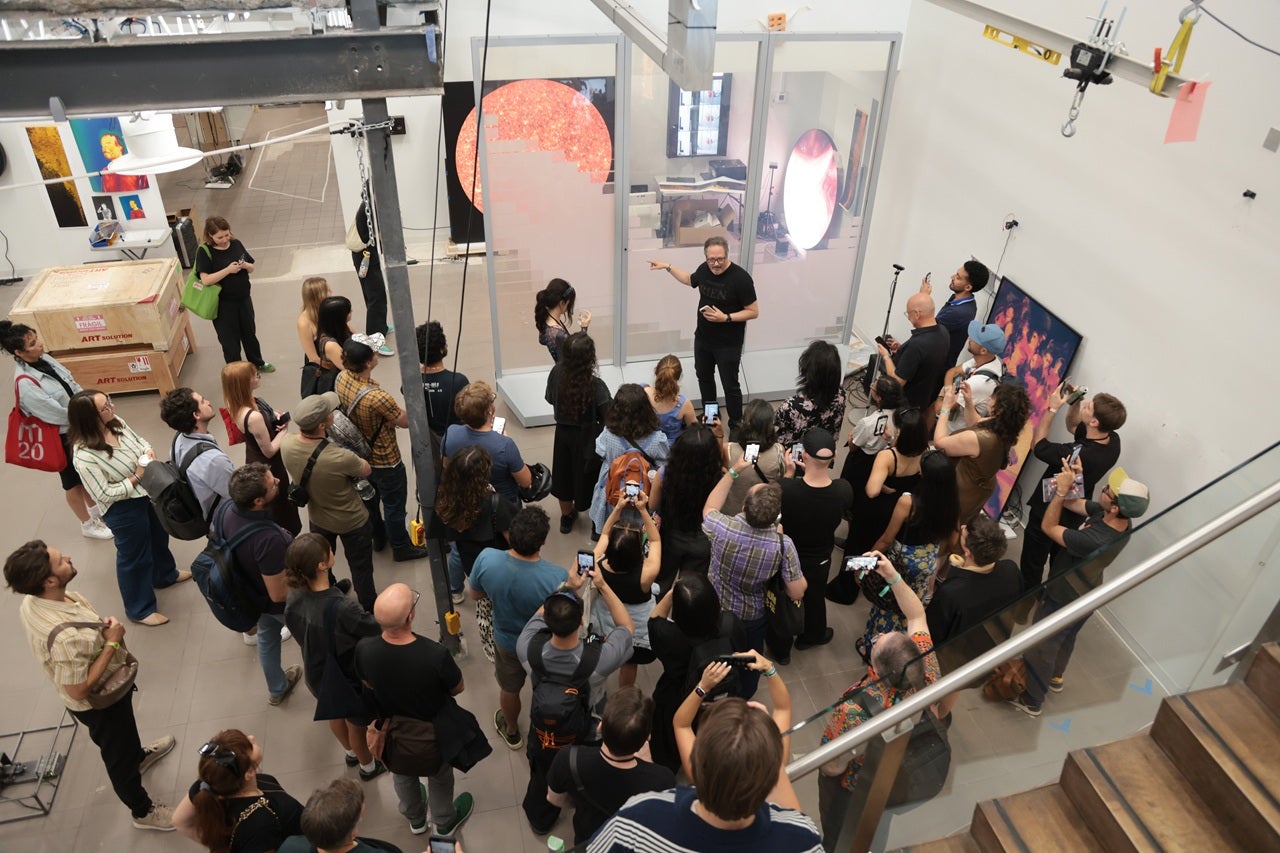
Artist Rafael Lozano-Hemmer leading a studio visit at the MUTEK festival in Aug 2025. Image Credits: Antimodular Studio
Unfinished Arch is described as an artwork completed through human presence. Where did the idea come from?
I became interested in a familiar photographic gesture: people posing with the Leaning Tower of Pisa, using their bodies to “hold it up.” That collective, playful fiction, where participation completes the monument, became a starting point.
At the same time, I wanted to reflect on modernity itself. I looked at mid-century arches, like Saarinen’s Gateway Arch in St. Louis from 1948, which embody a techno-optimistic vision – clean, mathematical, and symbolic of progress. Unfinished Arch borrows that language, a parabolic, almost Fibonacci-like curve with a precise geometric profile, but interrupts it. By leaving the structure incomplete and cantilevered, the piece becomes a monument to unfinished modernity: a project whose promises of progress and control over nature remain unresolved and, in many ways, have led us into crisis.
What does “unfinished” represent to you in public space?
The unfinished is a space of potential, it invites occupation. I’m also thinking of informal architecture in Latin America, where buildings are deliberately left with exposed rebar on their roofs so they can grow over time. That incompletion is not failure; it’s hope. Here, incompletion carries both fragility and responsibility. The structure appears to depend on you. It asks: what does it mean to sustain something collectively?
How did you approach the Toronto context?
I started by thinking about gateways: how the waterfront was and still is a gateway to the city. This took me to the typology of gateway arches and Bertolt Brecht’s quote, “Great Rome was filled with arches of Triumph, who built them? Over whom did the Caesars triumph?” Monuments are inseparable from power and selective historical narratives, like the Arch that Trump wants to build in Washington DC! Instead, I wanted to create an anti-monument, something that resists permanence and authority, and instead foregrounds participation and process. The full arch only “exists” when people complete it.
Toronto’s Dufferin Gate provided a useful precedent for a mid-century civic arch. I wanted to echo that language, but shift it toward something unstable and contingent, less about identity, more about becoming.
How did the waterfront site shape your decisions?
It was important that the piece remains modest and not dominate Sherbourne Common. The park is already a space for community gatherings and events. I positioned the arch closer to the water, so it acts as a destination and reinforces the waterfront as an entry point. The orientation is carefully calibrated: depending on where you stand, you can frame either the skyline or the lake, which encourages photography and personal interpretation.
Accessibility was central. The truncated end is stepped so people of different heights and abilities, including wheelchair users, can reach it. Multiple participants can collaborate to complete the gesture. There are also tactile paving indicators and a subtle auditory cue, a quiet ticking sound emitted near the lowest point of the cantilever, to assist visually impaired visitors in locating the interaction point.
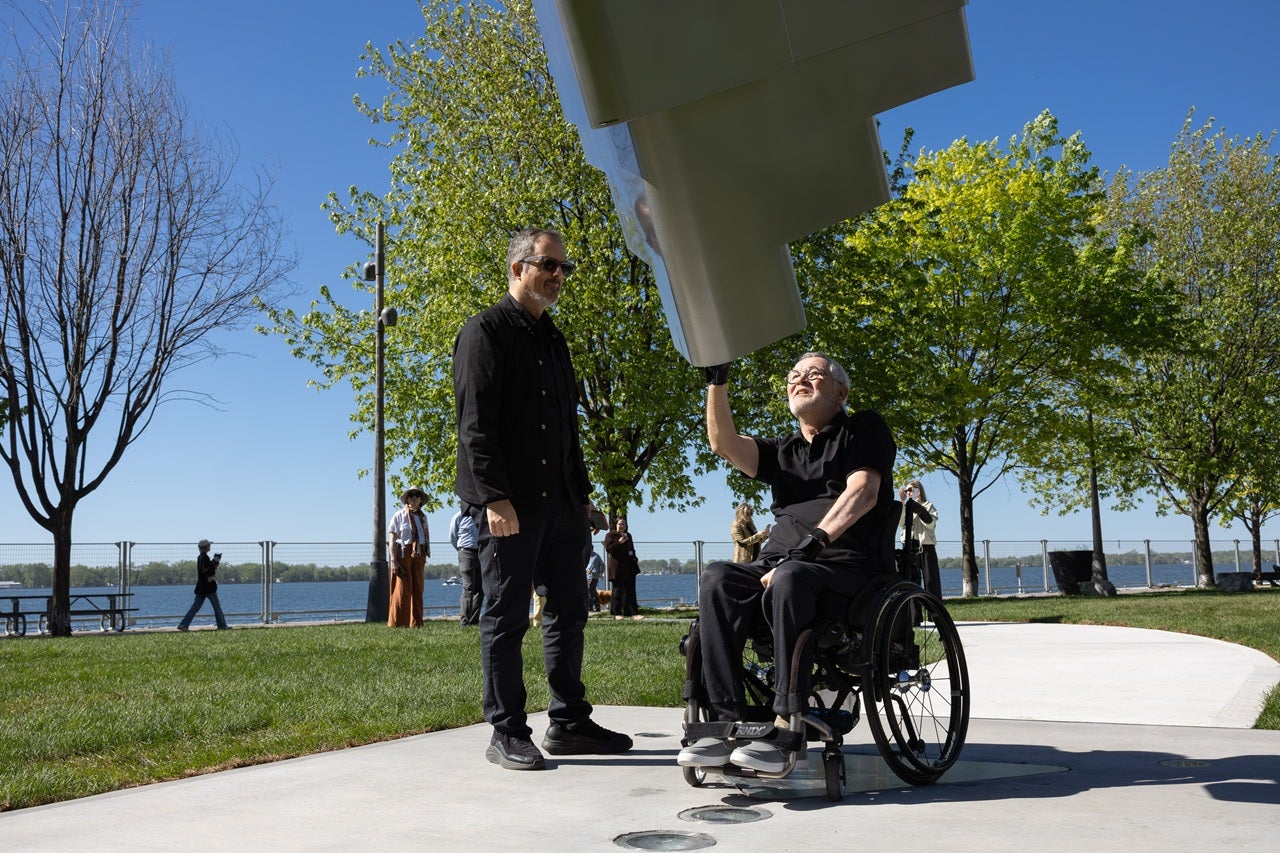
Dan Euser, a member of Waterfront Toronto’s Accessibility Advisory Committee, illuminating Unfinished Arch in Sherborne Common with artist Rafael Lozano-Hemmer.
The interaction feels intuitive, almost like you’re completing an electrical circuit.
Yes, that illusion is intentional. There’s a triangular metal plate on the ground marking where a missing support would be. When you stand on it and touch the arch, it feels like you’re closing a circuit. In reality, there is no current passing through the body. The system uses contact and proximity sensors embedded in the stainless-steel plates at the truncated end.
When activated, the arch responds with a light animation: over a thousand embedded LED points illuminate progressively, starting near the participant’s hand and traveling along the underside of the structure toward the base. When contact is released, the animation reverses, as if the energy dissipates.
Even during the day, the lighting is visible because it activates the recessed undersides of the triangular profile. At night, additional collimated uplights create a constant glow, while shadows from passersby subtly animate the structure.
The experience is fundamentally haptic. The structure has a slight, perceptible sway, reinforcing the sensation that your body is stabilizing something massive.
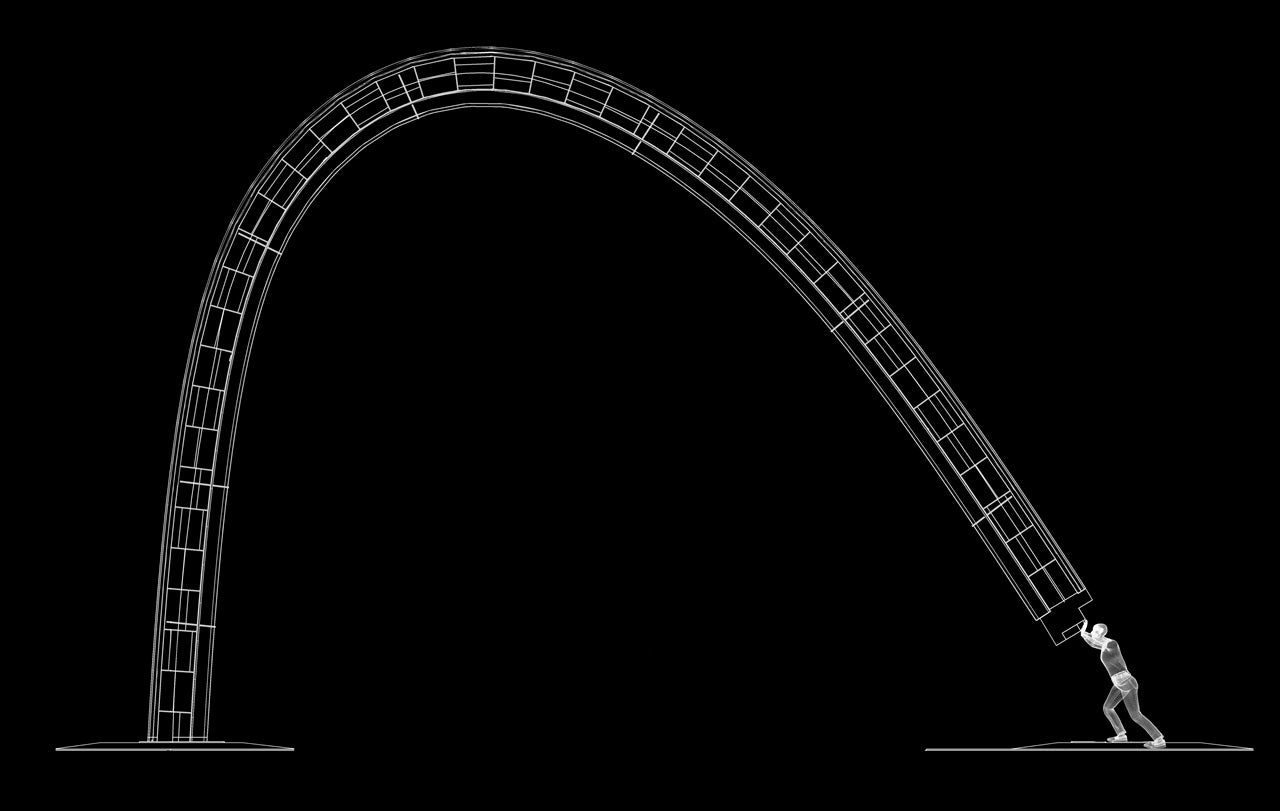
Early drawing of Unfinished Arch, 2022. Credit: Antimodular Research
How did community input influence the design?
We worked closely with Waterfront Toronto’s Accessibility Advisory Committee and City of Toronto teams, which shaped circulation paths, clearances, and interaction zones, in addition to the accessibility features described earlier. The goal was to ensure that participation is not symbolic but genuinely inclusive. This aligns with a broader interest in creating platforms for public self-representation, spaces where people don’t just observe, but actively produce the meaning of the work.
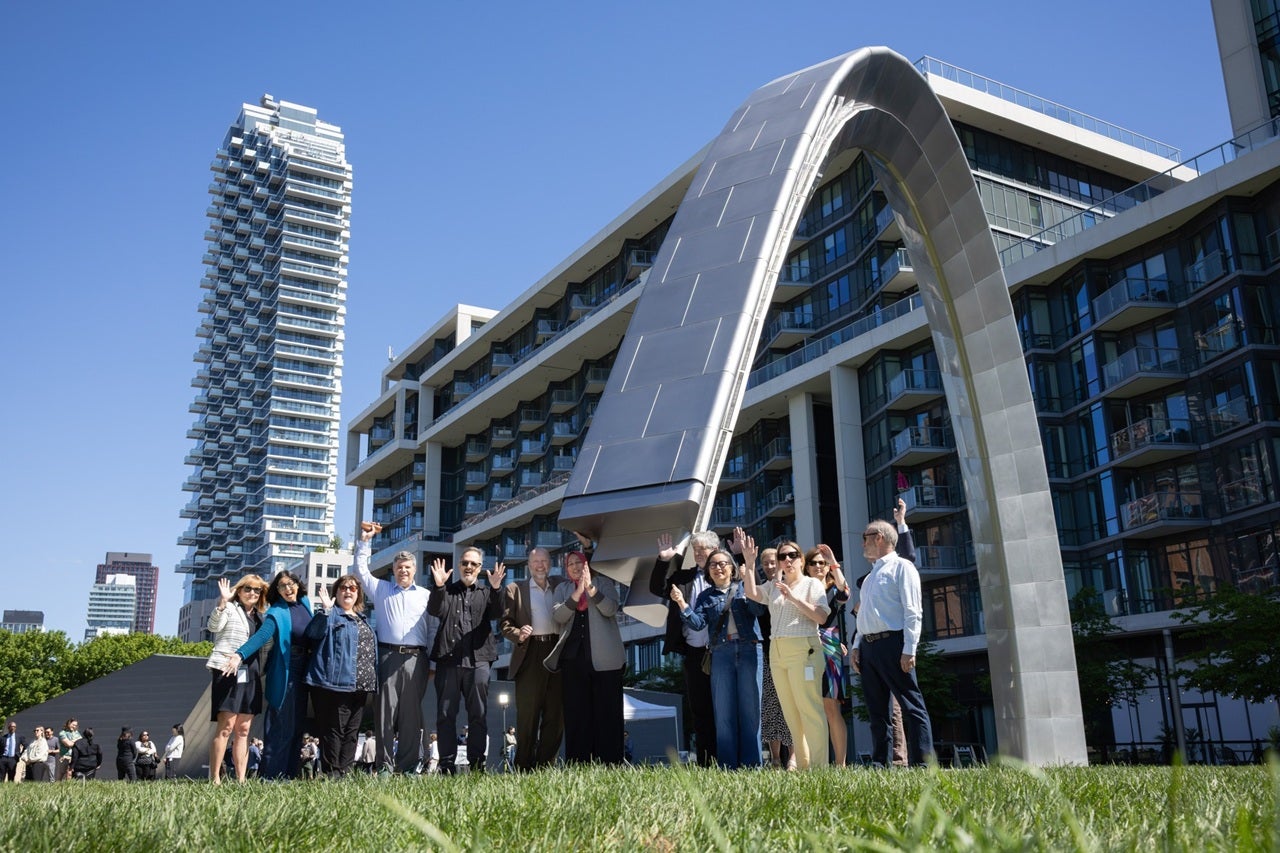
Waterfront Toronto leaders and guests celebrating the opening of Unfinished Arch in Sherborne Common.
What do you hope people take away from the work?
I hope they’re intrigued by a monument that depends on them. Most monuments are untouchable; this one requires contact. There’s empowerment in that, the sense that individual action can scale up to something urban. But there’s also a question of responsibility. The work suggests that systems – social, ecological, political, require collective support. At its core, Unfinished Arch is about the unfinished project of modernity. It asks whether we continue to sustain it as it is, or whether we imagine something else together.
Interview with the fabricators, Eventscape
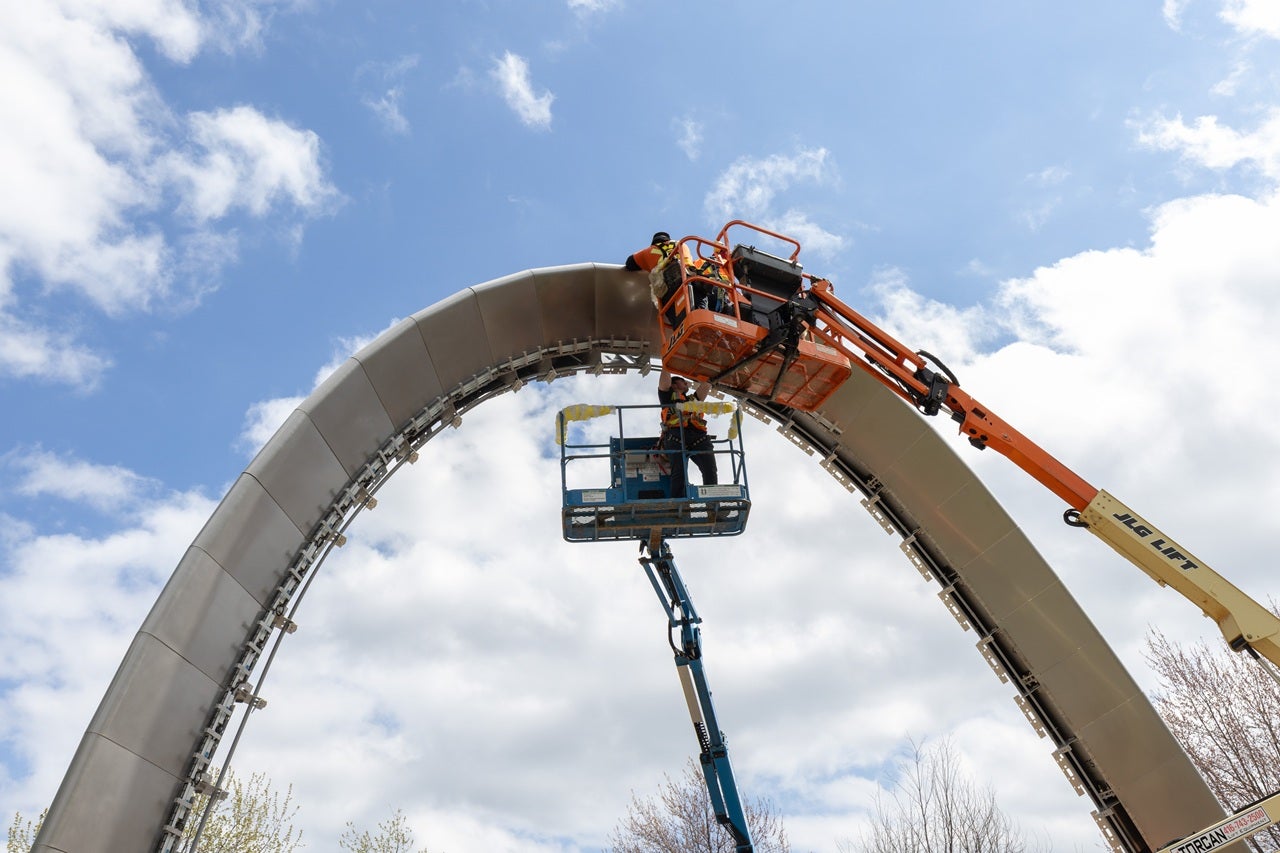
Eventscape crew at work in Sherbourne Common. Image Credits: Eventscape
Unfinished Arch is visually striking, especially because it appears to stand from a single support. From the beginning, what made this project unique or particularly intriguing from a fabrication perspective?
From a fabrication perspective, Unfinished Arch was compelling because the gesture appeared almost impossible: an incomplete arch suspended from a single point, with its outer edge hovering within reach of the public. While the work feels simple and intuitive, realizing it required significant hidden complexity.
Our role was to translate Rafael Lozano-Hemmer’s vision into a permanent public artwork capable of performing structurally, enduring Toronto’s waterfront conditions, appear monolithic, and yet elegant and approachable. The sculpture required significant structural engineering to support the cantilevered form while maintaining a refined exterior.
Much of the project’s complexity also lies below ground. Built on reclaimed waterfront land, the foundation demanded detailed geotechnical investigation and coordination. The result conceals an intricate system of structure, cladding, lighting, and site integration beneath a graceful public experience that feels effortless despite its technical demands.
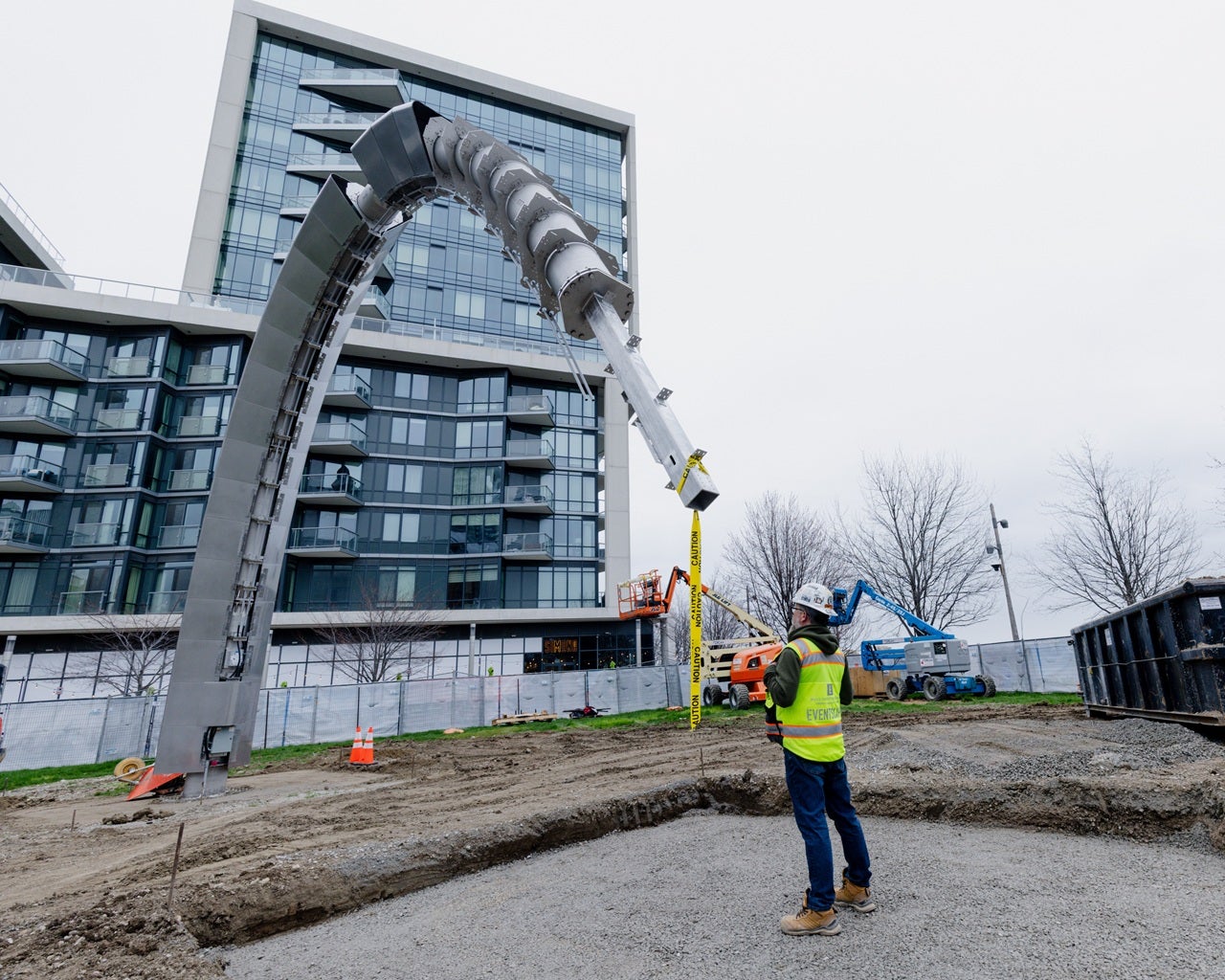
Behind the Scenes, Unfinished Arch Installation. Image Credits: Antimodular Studio
Installing a large-scale artwork in an active waterfront park comes with its own set of challenges. What did building Unfinished Arch at Sherbourne Common require your team to think differently about in terms of planning, coordination, and working in a public place?
A public artwork like Unfinished Arch must succeed on many levels at once. It needs to be structurally sound, durable, accessible, maintainable, and beautifully finished, while also feeling natural within the park environment. Every decision therefore had to balance technical performance with public experience.
One of the biggest challenges was precision. The main structure, a large stainless-steel spine, was fabricated in sections and assembled so the curve, cladding seams, and interactive endpoint aligned exactly as intended. Because the form is cantilevered, the structure naturally deflects under its own weight, requiring the team to predict and compensate for movement before installation rather than adjust afterward on site.
To achieve that level of accuracy, we relied on 3D scanning and digital coordination throughout fabrication and installation to verify fit, alignment, and finish. This planning was especially critical because the work could not be fully tested in its final condition beforehand.
The waterfront site introduced additional complexities, including public safety, underground infrastructure, freeze-thaw durability, and accessibility requirements.
Ultimately, the goal was for all of that coordination and engineering to disappear into the experience, allowing visitors to encounter the artwork effortlessly and intuitively.
From shop fabrication to on-site assembly, Unfinished Arch has been a complex journey. What has been the most exciting or challenging part for your team as the artwork gradually took shape on the waterfront?
The most exciting part has also been the most challenging: seeing the “impossible” nature of the piece become real.
In the shop, the work centered on precision, alignment, and constant problem-solving. Every component had to contribute to the larger gesture, with the structure, cladding, lighting, sensors, and finishes all working together while preserving the clarity of the artist’s vision.
On site, seeing the first major structural sections installed was a defining moment for the team. Until then, much of the work existed only in drawings, models, calculations, and carefully fabricated pieces. As the arch rose into place, its scale and presence became tangible.
The most rewarding moment will be seeing the public interact with it, when the technical work gives way to the human experience Rafael intended.
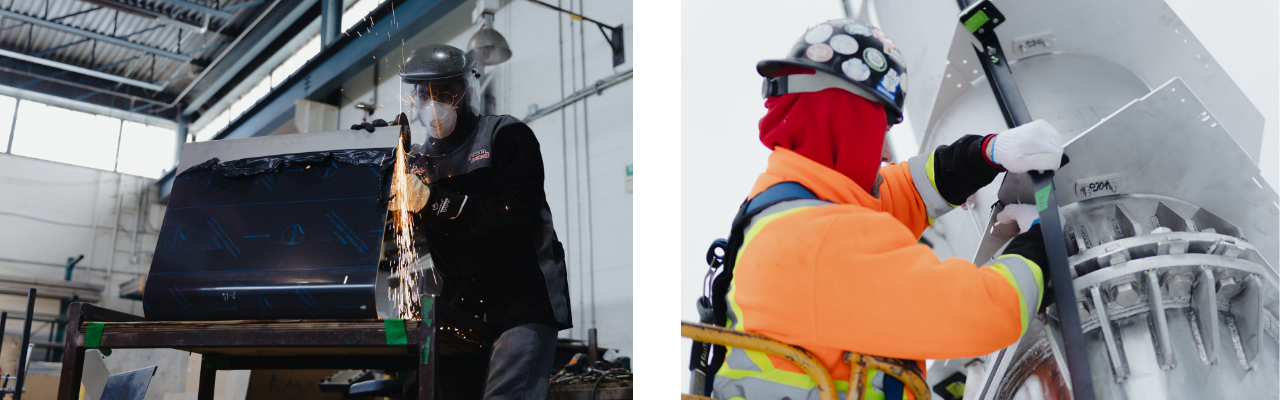
Eventscape crew at work in the shop (left) and at the site (right), Sherbourne Common. Image Credits: Antimodular Studio
As people begin to interact with Unfinished Arch, what do you hope they’ll appreciate or be curious about when they experience the artwork in person?
We hope people experience a sense of wonder. At first glance, the artwork prompts a simple question: how is this standing?
That curiosity is central to the experience. While the piece appears visually simple, it contains significant hidden complexity, from the foundation and stainless-steel structure to the lighting, sensors, and precisely coordinated cladding.
We also hope visitors recognize the collaboration behind the project. Public art at this scale depends on close coordination between the artist, engineers, fabricators, installers, accessibility specialists, City stakeholders, and many others. Every contribution supports the moment when a visitor reaches out, completes the arch, and activates the light.
Most importantly, we hope people enjoy it. Although technically demanding, the artwork is playful, approachable, and designed for public interaction, becoming a memorable part of Toronto’s waterfront experience.
Visit Unfinished Arch & Tell Us About it
Unfinished Arch in Sherbourne Common is open and waiting for you. Waterfront Toronto encourages the community to discover the artwork, engage with it, and make it part of their everyday experience on the waterfront.
If you post a story on your Instagram, feel free to tag us @waterfront.to. We’ll be delighted to see you enjoying the interaction.
Sherbourne Common is located at 61 Dockside Drive in Toronto’s East Bayfront neighbourhood, just south of Queens Quay East.
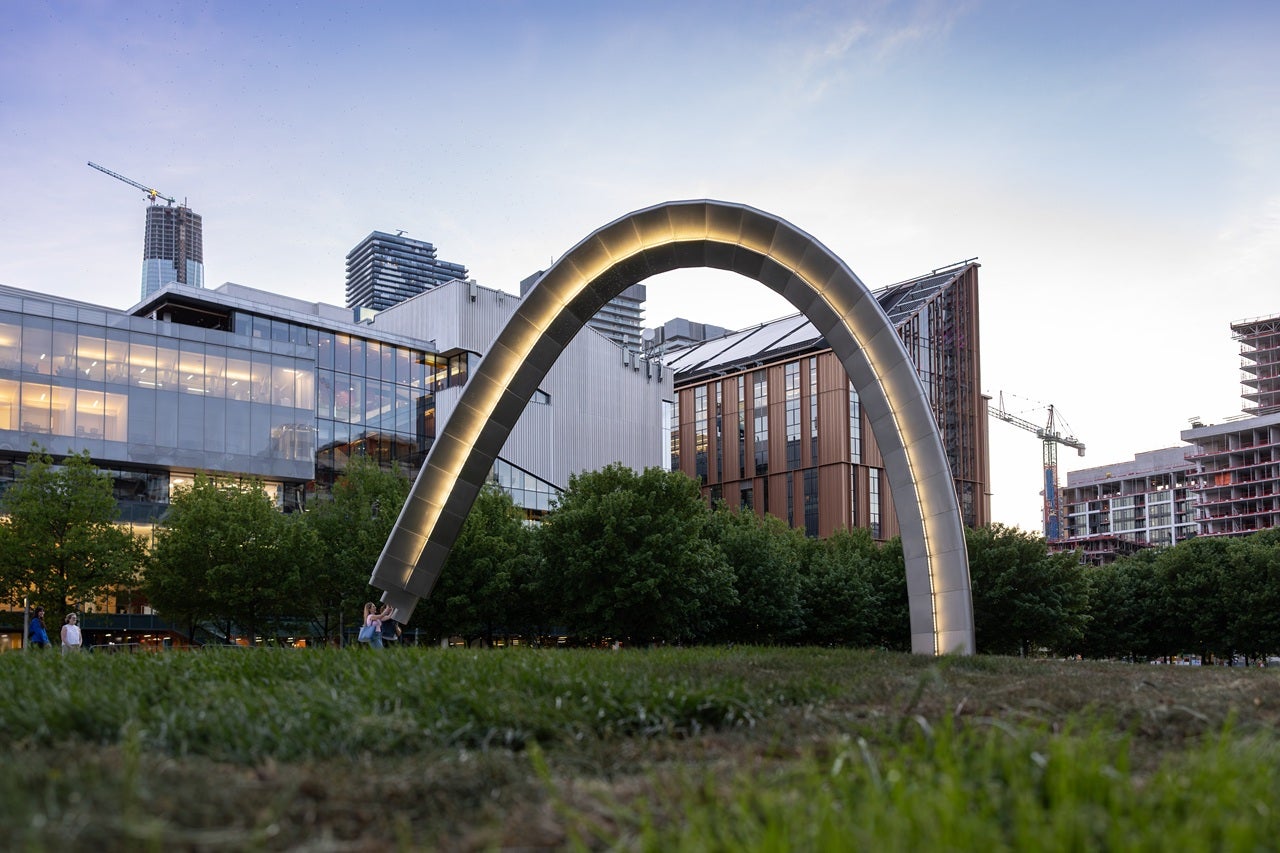
A visitor illuminates Unfinished Arch in Sherbourne Common.
Designed through community input, Unfinished Arch emphasizes accessibility and reinforces Sherbourne Common as an inclusive public gathering place at the water’s edge. Located at the southern end of the park, the artwork is a permanent addition to the neighbourhood that draws people to the waterfront and supports shared use of public space. It builds on Waterfront Toronto’s long term vision for East Bayfront, as outlined in the East Bayfront Public Art Plan, and complements earlier destination artworks such as Light Showers at Sherbourne Common (North) and LIGHTKEEPER at Aitken Place Park, forming part of a curated collection that animates public space and supports year round engagement.
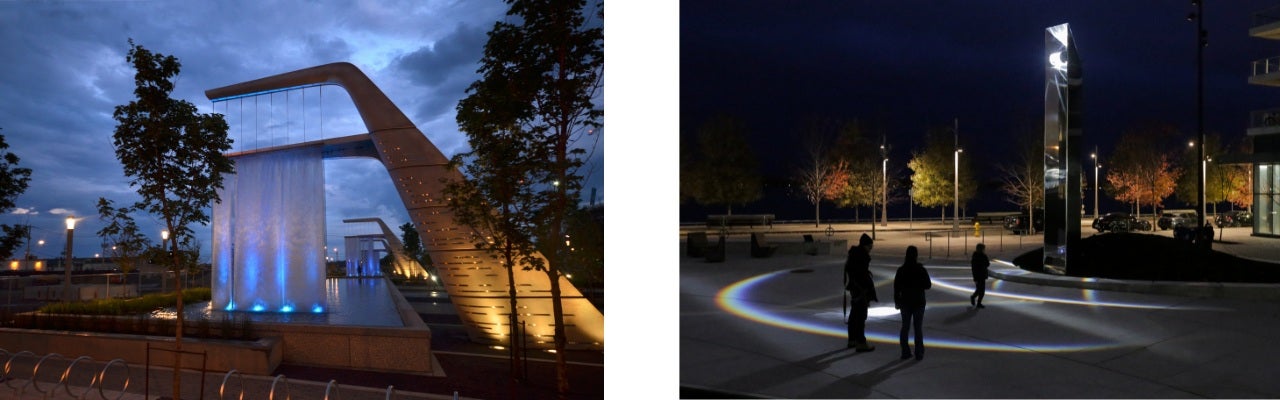
Light Showers (left) by Jill Anholt in Sherbourne Common (North) and LIGHTKEEPER (right) by Caitlind r.c. Brown, Wayne Garrett, and Studio North in Aitken Place Park